
Getting your new Voodoo set up dialled
Having bought a new mountain bike, you'll no doubt be desperate to get it out on the trails. However, before you do here are some tips on getting the most out of your set up. Mountain bikers can be particular about their set up and are normally more than happy to enter a debate about the best angle for your brake levers or best tyre pressures to run. This variety in opinion can make the process intimidating but our advice below can help you figure out what best suits you.
Setting up your cockpit:
When mountain bikers refer to the 'cockpit' of their bikes, they're talking about the handlebars and everything attached to them. There's plenty of adjustments that can be made which make a big difference to your comfort and how the bike handles.
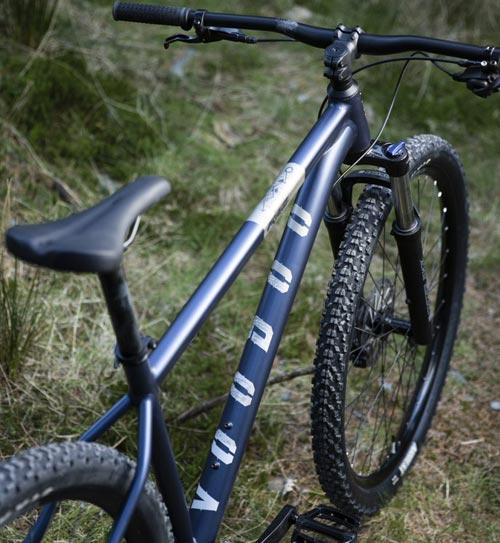
The most crucial thing when out on the trails is the ability to stop safely, so the first thing to consider is how you want your brake levers set up. Before anything else, you'll want to decide where on the handlebars you want the levers fastened. This depends on how many fingers youuse to trigger the brake levers. Consider whether you brake with one, two or three of your fingers as there's a trade-off between how well you can grip the bars (one finger braking helps with a strong grip) and how confidently you can grab the brakes (new riders often tend to prefer a strong 2 or 3 finger brake hold). Set you brake lever position such that you can comfortably pull the levers whilst holding the middle of the grips. It’s worth knowing that some high-end levers are specifically designed to be used with just one finger. You'll spot them because the levers are significantly shorter.
The second thing to consider with bike brakes is the angle that the lever sits at in relation to the ground. You'll notice most mountain bike riders have their levers pointing further down than you might expect . A great starting place for setting up your position is to have the levers such that, when you're sat on the bike and your hands are resting on top of the levers, there is no bend in your wrist. Once you're familiar with your 'attack position' (the stance you have on the bike when descending), you can adjust the brakes to be lined up when you're in it. You'll notice that you'll need to move your gear shifter(s) around, along with your brakes, as they sit underneath. For most riders, it's best to keep the gear lever tucked up against the brake but do what's comfortable for you.
A final consideration is the stacking of your spacers and stem. There's good reason for the small spacers which sit around your stem on the top of the fork steerer. You can reorder the spacers and stem to change the handling characteristics of your bike.
Most new bikes will come with the handlebar in the highest position - moving it down will shift your weight forward slightly, adding grip to the front wheel. However, this will also make it harder to lift the front wheel into the air, a key skill for navigating drops on the trail. You want a neutral position on the bike, without too much weight on your wrists or a light front wheel. You can play with your stacking to achieve this.
Optimising your saddle position:
Possibly the biggest innovation in mountain biking in recent years has been the advent of the dropper seat post. When out on the trails, mountain bikers want their seat high for climbing but all the way down and out of the way to allow the bike to move beneath them whilst descending. Actuated by a lever on the handlebars, a dropper seat post allows you to quickly transition between saddle heights without getting off the bike. Gone are the days of having to get off and manually adjust your saddle! Best of all, the saddle always returns to the exact spot you've set it to for easy climbing.
This is a really important thing to know - having the saddle even an inch or two too low can dramatically affect how easy you'll find climbing. Whether you've opted for a dropper or not, you'll want to make sure that your saddle is set such that your legs are almost straight when at the bottom of the pedal stroke. A top tip for dialling it in is to get your leg completely straight when your heel is rested on the pedal at 6 o'clock. When you then bring the ball of your foot to rest on the pedal, it will introduce just enough bend in your knee.
If you don't yet have a dropper but plan to ride trails where you'll want your saddle down and out of the way, mark the seatpost where it enters the frame so that you can always reset it to the right spot from the climbs.
Saddle angle is also an important consideration. It's best to start with your bike saddle in a level position. This is how they are designed to be sat upon. If you find this puts pressure on your soft tissue when you lean forwards, then you can try tilting the nose down by a few degrees. We'd recommend starting with your saddle clamped in the middle of the rails. This puts it in a neutral position which will work for a lot of riders. If you know your legs are proportionally longer than your upper body, then you could move it backwards, or forwards if your legs are proportionally shorter.
Lets talk tyres:
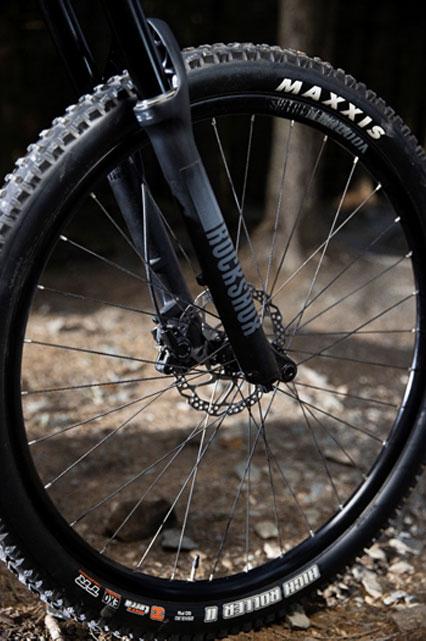
Modern mountain bikes often come with a good set of tyres, for instance the Voodoo range all feature tyres from Maxxis, the favourite brand for mountain bikers in the UK. However, there are various considerations that may mean you want to upgrade.
Tread patterns vary between mountain bike tyres, some are designed to be as fast as possible and are suited to drier, harder terrain. Meanwhile, others are all about grip and feature large knobs across their surface to maximise traction on looser and wetter ground. Most riders in the UK will opt for something in the middle with a slightly smoother centre and prominent knobs on the outer edges to give better grip when cornering.
Increasingly riders run two different tyres on their bikes, the back tyre will be a smoother faster tyre to aid speed, but the front tyre will be grippier to ensure that it grabs the ground as you turn. This set up can be found on the .
All new Halfords bikes come shipped with inner tubes inside the tyres to keep them inflated. However, some bikes feature tubeless ready rims and others come pre-fitted with tubeless ready tyres. Tubeless set-ups allow riders to run lower tyre pressures (as there's no risk of pinching and popping your inner tube) which result in more grip from the tyres. As a small amount of sealant is poured into the tyre during installation, tubeless set-ups will self-heal if the tyre is punctured. Usually ditching the inner-tube results in an overall weight saving too!
So, if you have tubeless ready rims you'll likely be thinking of whether to go for some tubeless ready-tyres and you'll certainly feel the benefits if you do. If your bike came with both tubeless-ready wheels and tyres (as per the Voodoo Zobop, then all you'll need is a tubeless conversion kit to get going . It’s worth noting a specialist tyre booster may be needed to install them so visit your local Halfords store for a tubeless conversion kit.
The final consideration is tyre pressure, some riders love a rock-hard tyre which rolls as quickly as possible and gives a lively ride, whilst others will opt to run their tubeless set-ups as low as they can to give maximum grip in corners. Tubeless set-ups can often handle pressure as low as the high teens (PSI) and this will help to hold onto wet orunstable ground whilst tubed set-ups will need to be over 30 PSI - the sidewall of the tyre will state the range you can safely run. For the same reason as the mixed tyre set-ups mentioned earlier, many keen riders will run their front tyre at a lower pressure than the rear.
Check out our range of bikes tyresSetting up your suspension:
Coil sprung forks are designed to suit the majority of riders and whilst they can be adjusted slightly through a pre-tension cap (usually on the left fork leg), most riders will just get cracking with the factory settings. Air forks, however, are designed to give several means of easy adjustment and one you'll want to get dialled before you ride is your 'sag'.
Sag is simply how much the fork compresses under your bodyweight alone and can be altered by adding or removing air from the chamber in your left fork leg. To do this you'll need a shock pump, they're well worth investing in. However your in-store Halfords team can do this for you during the handover of a new bike. To get this right, lean against a wall and get into a neutral standing position on the bike to see how much your fork compresses. The aim is to adjust your air pressure so that around 20-25% of the fork leg lowers into the fork as you apply your weight. Some forks have an o-ring so that you can easily tell how much lowered once you're off the bike. Although, you can loosely fit a cable tie in lieu of this.
On full-suspension bikes, you'll want to do the same thing with your rear air shock, and again 20-25% sag is ideal for most shocks. Manufacturers such as Rockshox provide guides on rough pressures based on various weights which can make the job even easier!
Swapping componentry:
Now this section is primarily for the experienced riders and is something you'll more likely think of doing once you've put in the miles on the trails. Although modern bikes feature many points of adjustment, you may wish to swap out parts for ones even more suited to you as a rider.
You may find that even with the stem at its highest setting, you're struggling to shift your weight rearward enough to upweight your front wheel when descending. Although technique plays a huge part in this, for some riders you may consider fitting a handlebar with more rise to help keep your weight a little further back. If the bars are wider than the originals, this might counteract the benefit slightly so be mindful (although alloy bars can easily be shortened using a pipe cutter).
Most experienced riders have a preferred saddle brand, or even a specific model. In fact, all Voodoo models are fitted with WTB Volt saddle as it is a known favourite in mountain bike circles. You may have friends who have several saddles lying around that didn't quite work for them, so ask to give them a go as it can be quite challenging to choose a saddle, having not tried it out.
Modern 1x (or 1-by) drivetrains capitalise on huge rear cassettes to entirely eliminate multiple front chain rings. Cassettes, which range from as little as 10 teeth and right up to 51, mean that you can take on relentless climbs and blistering descents all with the same front ring. These have become a must-have in mountain biking and feature on all new Voodoo trail 29ers. You can however, tailor your set up by changing the size of the front chainring. A smaller front chainring will make climbing easier but you'll sacrifice how quickly you start to spin out when descending in top gear. Conversely, you can opt for a large front chainring to let you keep the power in for longer but you'll have a bit more work to do on the climbs. Just getting a chainring with two more or two less teeth can make a big difference but make sure you get one with the same bolt pattern (BCD).
Get out there...
Understanding the adjustments above and their impact on your ride can make a huge difference, not only on the potential of your skills and speed but your enjoyment and comfort too. So, get out on the trails and enjoy your bike and you'll feel where you need to make tweaks as you go!
Back to Expert Advice